QWERTY
This series examines the humble keyboard not just as a set of hardware inputs, but as a mirror reflecting our online behaviors. From keyboard-warrior conflict to collaborative play in virtual worlds, this everyday interface deeply shapes how we communicate and connect.
By scaling up and recontextualizing these familiar controls, the work invites us to reflect on how a simple keystroke can yield a profound real-world impact.
Nothing to See Here
Command + H Keys
“Nothing to See Here” centers on (Command + H)—the ubiquitous keyboard shortcut for hiding your active window in an instant. It doesn’t quit the application or risk losing your work; it simply sweeps the screen clean the in a moment of unwanted attention. This kinetic piece acts as a physical mirror to our online stealth behaviors.
Knowing that we can quickly conceal what we’re viewing with a shortcut may provide comfort or a sense of relief from surveillance. However, in the digital age, can we truly hide? And by participating in digital life, do we become part of a modern-day panopticon?
Physically, the work consists of two enlarged, precision-crafted wooden keys—(Command and H)—built from rich layers of Purple heart and Padauk wood. Concealed within these wooden shells are motors, LEDs, and a motion sensor.
When left alone in an empty gallery space, the sculpture is relaxed and open: the keys glow with vibrant, dancing colors and sit gently above their base. But the moment the motion detector senses a viewer approaching too closely, the sculpture panics. The keys abruptly drop flat against their base and the light becomes still and turns a defensive red.
“Nothing to See Here” imagines an interface mechanism built for self-preservation. But by making the hardware physically react to the viewer’s presence, “Nothing to See Here” asks us to reflect on why we hide: A healthy boundary to protect our privacy and agency? A response to labor surveillance? Or is this short cut a reflex born of guilty pleasures of digital life and the fear of judgment?
We Don’t Need Another Algorithm
Left and Right Shift Keys
We Don’t Need Another Algorithm marks a shift in scale and form—it is the first piece in the series to step off the wall and become a fully three-dimensional, freestanding sculpture. Standing at roughly twelve inches high, the work consists of two distinct components: a Left SHIFT key and a Right SHIFT key crafted from Purple heart wood, copper, resin, and embedded LEDs.
The illuminated text on each key constantly cycles through color spectrums. On the left key, a moderate, centrist purple slowly transitions into deep blue. On the right, that same centrist purple shifts toward deep red, eventually washing out to stark white. This color shift visualizes how social media algorithms manipulate our perspectives to maximize engagement—pulling us out of shared ground and pushing us into partisan filter bubbles.
Beneath each key, bent copper wires spill out like exposed roots or nerve pathways, visualizing the hidden flow of data harvesting. Every single bend in the wire represents 500 data points. Together, the wires render the invisible 54,000 bits of personal data that platforms like Meta and Google collect on us while we innocently chat with friends, share images of our lunch or search for cat videos.
Here, the hardware’s function is recontextualized. On a standard keyboard, holding down a Shift key alters our characters. In We Don’t Need Another Algorithm, the keys reveal how tech platforms use our data to silently shift us.

Scream
Caps Lock key
SCREAM—the single key capable of toggling the entire tone of our communication—is an oversized, wall-mounted Caps Lock key built from birch plywood and black-stained MDF, crowned with an animated LED indicator light that continuously spins in a hypnotic circle.
The title SCREAM directly invokes Edvard Munch’s famous painting The Scream of Nature. In popular culture, Munch’s figure has become the universal emblem of existential anxiety—a feeling many of us mirror today when confronted with a wall of ALL-CAPS text in an email, text, or DM.
We’ve been using all-caps to signal shouting in print media since at least 1856, according to printing historian Glenn Fleishman. Historically, capital letters were used sparingly for emphasis. But in the internet era—amplified by political figures and armies of online trolls—all-caps has morphed into a tool for performative strength, authority, and dominance.
The spinning indicator light on SCREAM reflects that downward spiral of social media discourse: a single keystroke shifting a message from civil to unhinged, exposing how easily a keyboard shields us while we unleash our worst impulses.
But juxtaposed against that manic indicator light, the text on the physical key itself is set strictly in lowercase. This is intentional. Lowercase type has emerged as a form of cultural resistance to online noise. Where constant uppercase yelling has become deafening, lowercase has come to represent intimacy, authenticity, and vulnerability—a shift popularized by artists like Taylor Swift and Billie Eilish titling entire albums in soft, uncapitalized type. In internet linguistics, lowercase signals casual intimacy, a soft voice, or emotional honesty, standing in direct opposition to the aggressive performativity of ALL-CAPS.
The caps lock key here isn’t yelling at the viewer; it’s quietly urging us to practice restraint.

Endlessly Running
WASD keys
Endlessly Running is a collection of oversized WASD keys—the universal directional controls for PC gaming. Illuminated with the signature glow of a modern gaming setup, these keys are static and locked in place. Crafted from heavy-duty birch plywood and OSB, they mirror the rugged durability of a makeshift gaming desk built to endure thousands of hours of intense play.
The work is both a nod to and a reimagining of Gabriel Orozco’s 1995 sculpture, Horses Running Endlessly. Orozco famously expanded a chessboard to 64×64 squares and filled it entirely with Knights—stripping away the King and Queen, eliminating win conditions, and leaving the horses to wander the board aimlessly.
Here, I explore that same condition of existential drift, but shift the focal point from the board game to the digital screen. In traditional gaming, the WASD layout is ergonomically sculpted to sit effortlessly under three fingers, granting the player total precision and control over their character. By scaling these keys far beyond the human hand, I strip them of their utility.
Without a player’s hand to anchor them, the physical controls become useless—leaving the digital avatar to run endlessly through its virtual world, liberated from our command, but forever lost without a guide.

Untitled
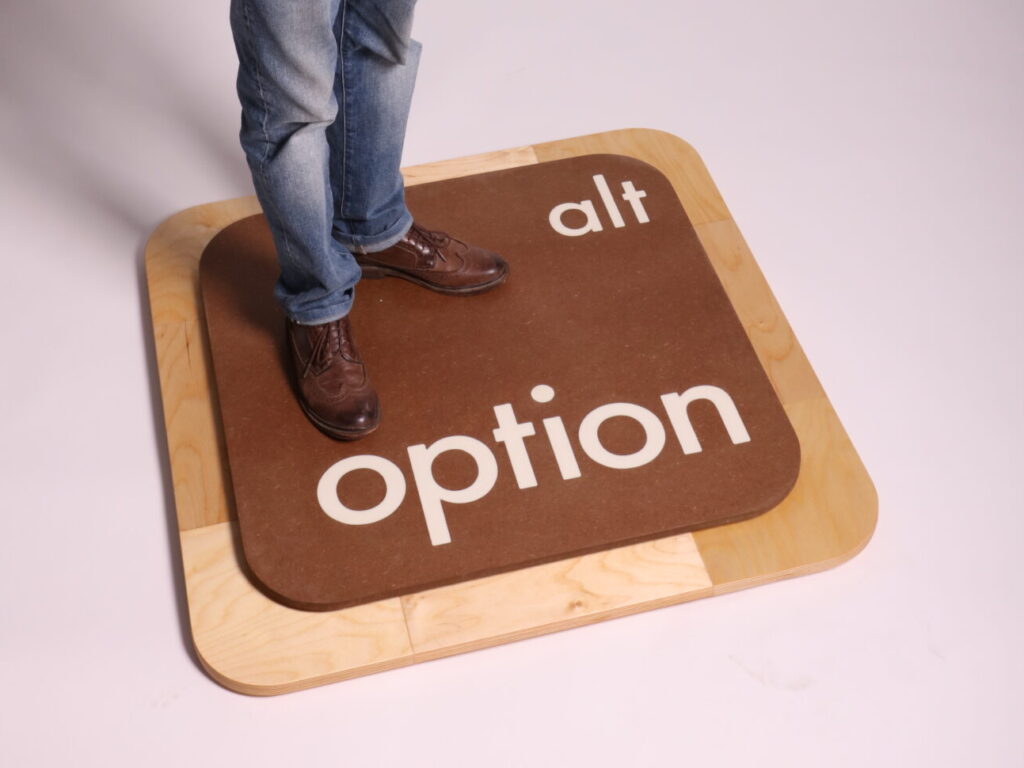
alt option key
Can a key be more than an input device? Can it act as a mirror?
That question birthed the broader QWERTY series. Keys are no longer just plastic buttons; they are representations of human intent and online behavior. From the deafening roar of ALL-CAPS shouting in SCREAM, to the aimless digital wandering of Endlessly Running, these pieces examine our online existence. The exact same key press can connect us in a cooperative game or tear us apart in a comment section.
With this series, viewers are invited to step back from the screen, look at these magnified controls, and reflect on what you unleash every time you tap a tiny key.